Programming in R
Input and Output
Typical print message:
x <- 5.8
cat("The result is",x,"N/m.\n")
## The result is 5.8 N/m.x <- readline("Enter x: \n")## Enter x:x## [1] ""x <- as.numeric(x)
x## [1] NAConditional Execution
The traditional if… else… syntax in R
x <- 6
y <- 0.5
if (x>2 & y<1){
  print(x)
  print(y)
}else{
  cat("Warning, x<=2 or y>-1\n")
}
## [1] 6
## [1] 0.5Loops
R has powerful indexing power, therefore loops are needed considerably less ofen than in any conventional programming language.
for (f in seq(1,10,by=2)){
  cat("Square root of",f,"is",sqrt(f),"\n")
}
## Square root of 1 is 1
## Square root of 3 is 1.732051
## Square root of 5 is 2.236068
## Square root of 7 is 2.645751
## Square root of 9 is 3Try to avoid loops if possible. Here is an alternative of the above codes:
x <- seq(1,10,by=2)
ee <- paste("Square root of",x,"is",sqrt(x),"\n")
cat(ee)
## Square root of 1 is 1
## Square root of 3 is 1.73205080756888
## Square root of 5 is 2.23606797749979
## Square root of 7 is 2.64575131106459
## Square root of 9 is 3Commands apply, tapply, sapply are commonly a better approach.
User-defined Functions
function.name <- function(argument1,argument2,…)expression
For example: calculating a geometric mean, which defined as \(n^{th}\) root of the product of n numbers:
\[S = \sqrt{\prod_{i = 1}^{n} f(x_i)}\]
geo.mean <- function(x){
  z <- prod(x)^(1/length(x))
  return(z)
}
x = seq(1,100)
geo.mean(x)
## [1] 37.99269Arguments to Functions
Pass them in the order matching the function’s definition
Supply the arguments in the form argument.name = value in an arbitrary sequence
my.plot <- function(x,y,symb="+",color="red"){
  plot(x,y,pch=symb,col=color)
}
x = seq(1,20,1)
y = seq(5,24,1)
my.plot(x,y)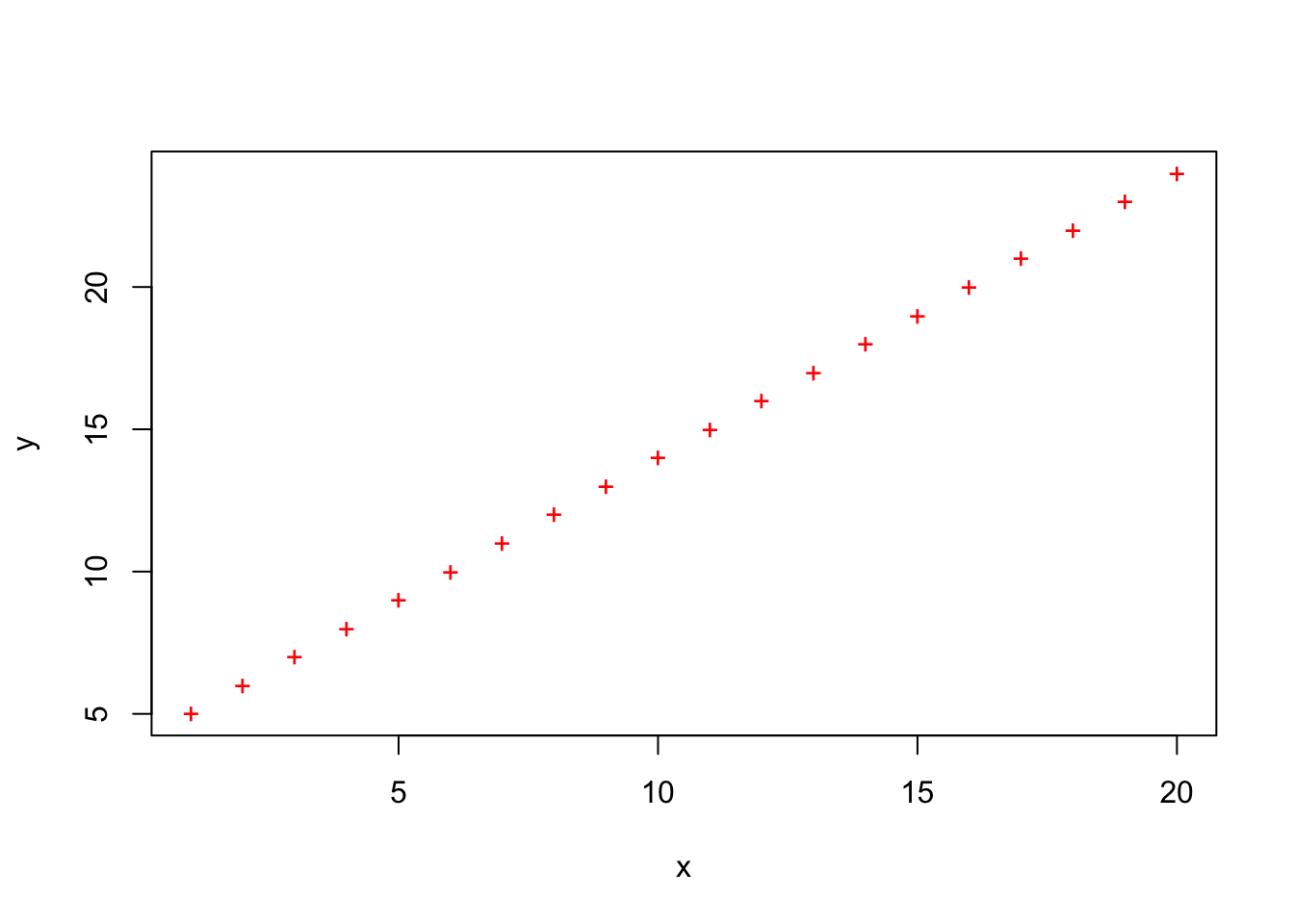
my.plot(x,y,"o")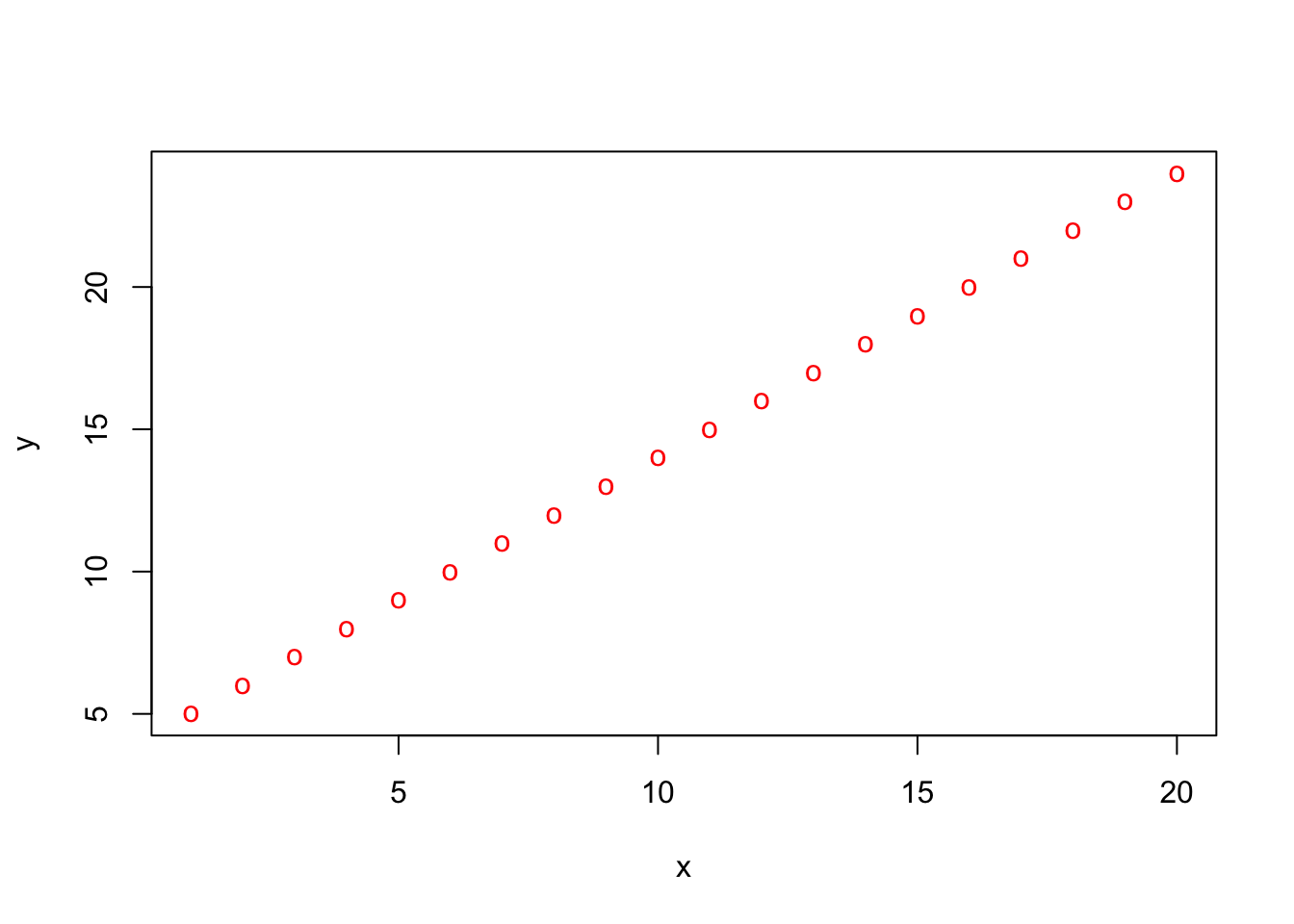
my.plot(x,y,color="blue")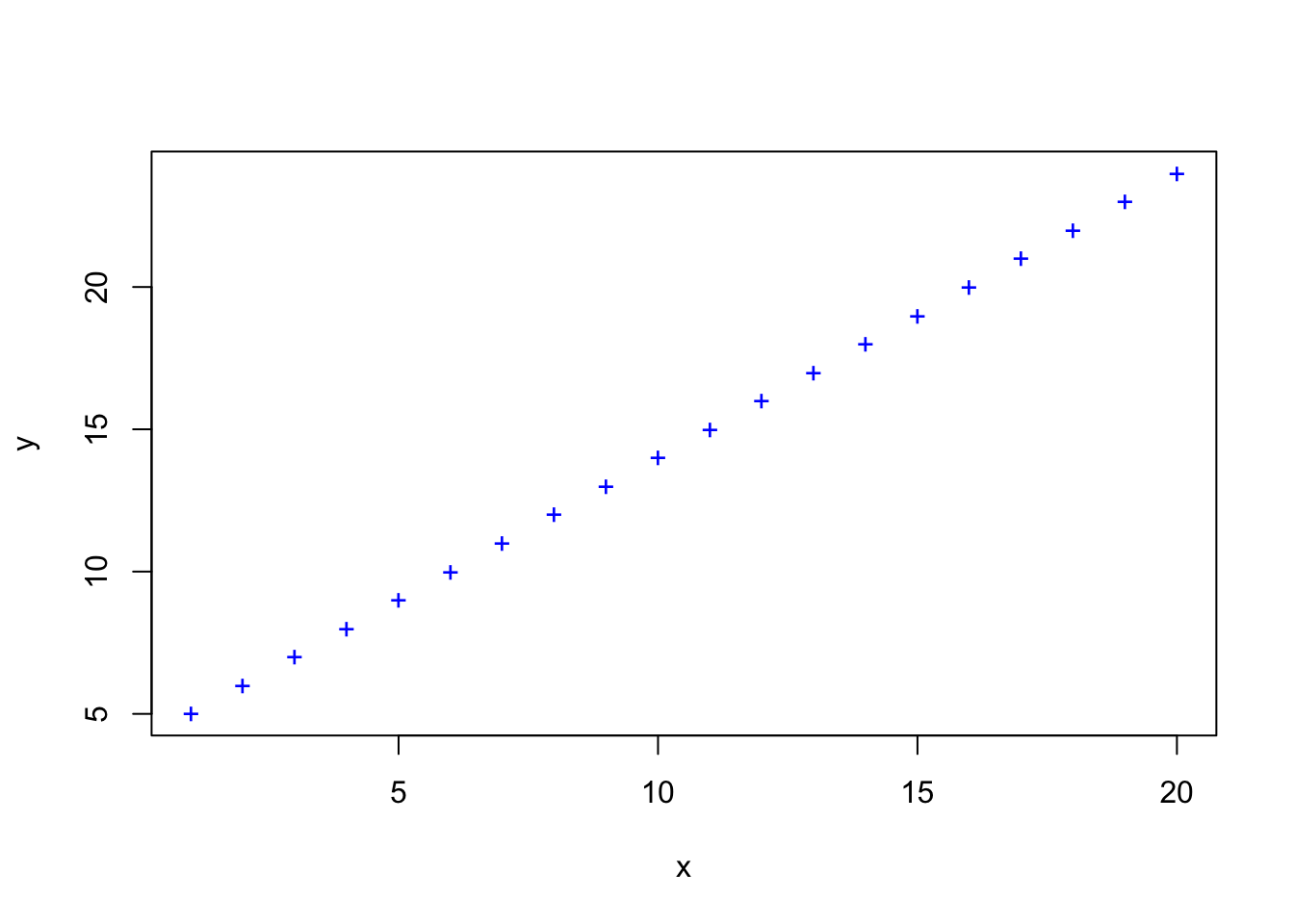
args("my.plot")## function (x, y, symb = "+", color = "red")
## NULLAn alternative to Loops - sapply
sapply(x,FUN): apply a function FUN over a vector x.
sapply(seq(1,10,by=2), function(i){
  z <- paste("Square root of",i,"is",round(sqrt(i),3))
})
## [1] "Square root of 1 is 1" "Square root of 3 is 1.732"
## [3] "Square root of 5 is 2.236" "Square root of 7 is 2.646"
## [5] "Square root of 9 is 3"
Share this post